
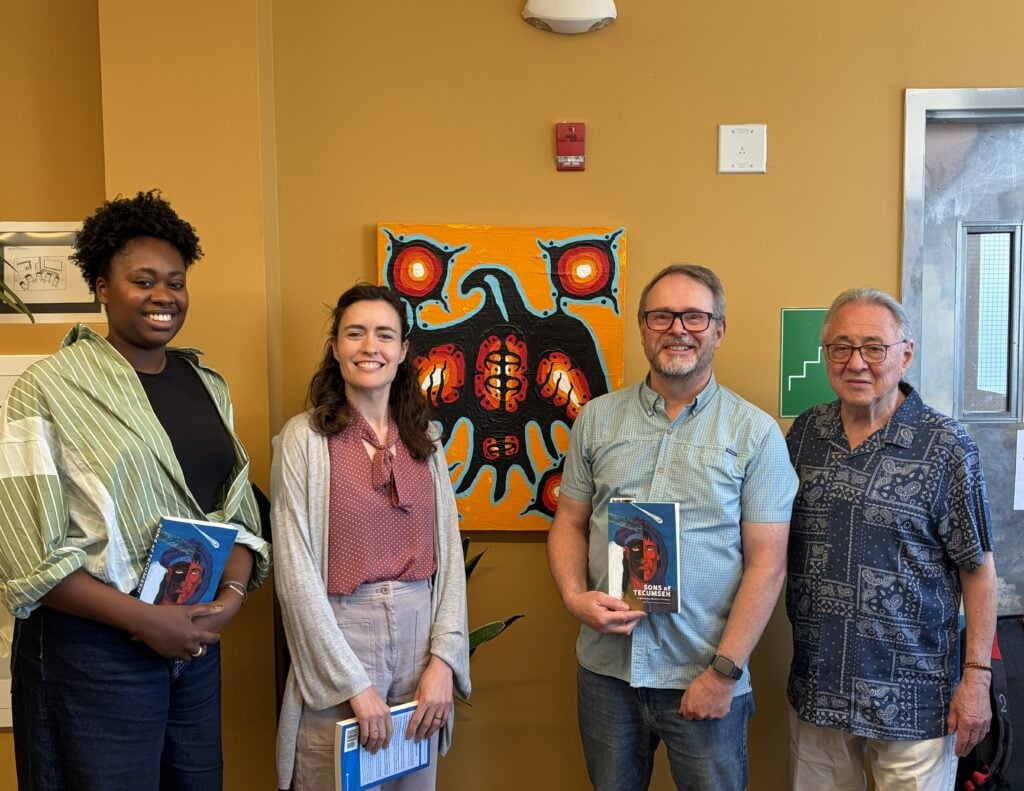
Recently, our team had the opportunity to learn from Maurice Switzer, a citizen of the Mississaugas of Alderville First Nation in southern Ontario and author of Sons of Tecumseh. Prior to the session, Maurice invited us to read the Introduction and Chapter 11 “So Long As the World Exists” from his book, which helped ground our conversation in treaty rights, treaty relationships, and the responsibilities that continue to flow from them.
This session was part of an ongoing monthly reading group at Taylor Newberry Consulting, where our team is learning about Indigenous histories, perspectives, and contemporary realities. Some of our learnings so far include the Sixties Scoop, residential schools, Indigenous identity, power, and intersectionality (you can find a list of some of our readings below). This learning is helping us build a stronger foundation for engaging thoughtfully and respectfully with Indigenous partners, advisors, and communities in our work.
In this blog post, we wanted to share some of our learnings from our session with Maurice. We are sharing these reflections because we see learning about treaties and colonial histories as part of our collective responsibility to deepen our understanding of the histories and relationships that shape the work we do. Sharing some of what stayed with us is one way of holding ourselves accountable to that learning, and of making visible the commitments we want to carry forward in our practice.
Colonialism, Patriarchy, and the Shaping of Power
One of our key takeaways from the session was a deeper understanding of the relationship between patriarchy and colonialism. During our session, Maurice shared an image of treaty negotiations between European settlers and Indigenous leaders and invited us to notice who was missing from the scene. There were no women pictured. He reminded us that, in many Indigenous societies, women historically played central roles in decision-making, including helping choose Chiefs, determining where communities would live, and shaping collective decisions. This stood in sharp contrast to the colonial governance structures being imposed, in which power was concentrated among men, and women were excluded from formal authority.
It was particularly striking that the treaty process, as a system imposed through colonial governance, excluded women from positions of authority and decision-making. Our session highlighted how colonial ideas about status, power, religion, and gender became embedded within institutions through treaty-making processes that excluded women, governance systems that imposed Western models of authority, and legal frameworks. These systems reshaped roles, relationships, and decision-making structures in ways that continue to be felt today.
Building and Honouring Our Relationship with the Land
Another teaching that resonated with many of us was the reminder that when we take something from the earth, we have a responsibility to give something back. Maurice shared the example of offering tobacco back to the earth when hunting or harvesting. This teaching invited us to continue to think differently about land, not as a resource to be used, but as a relationship to be honoured. It also challenged us to think about land acknowledgements as a starting point for better understanding the responsibilities that come with living and working on the land.
In practice, this means we are continuing to learn about the specific lands and treaties connected to where each of us lives and works, being more thoughtful about how we use and benefit from the land and looking for concrete ways to support Indigenous-led priorities and relationships in our communities.
Speaking from the Heart
In reflecting on how our learning applies to our work, our team was particularly struck by the Anishinaabe word for truth, Debwewin, which Maurice described as meaning “spoken from the heart.” This framing expands the concept of truth beyond sharing what we believe to be factually accurate. It emphasizes authenticity, relationality, and personal responsibility. This perspective feels especially important to our work, where genuine engagement with the communities we have the privilege of working alongside depends on listening carefully, showing up honestly, and speaking with care.
What’s next for TNC’s Truth & Reconciliation Work?
As a team, we left the session reflecting not only on what we learned, but on what we are responsible for doing next. Maurice’s teachings built on the learning we have been undertaking through our ongoing reading group and challenged us to think about how that learning translates into action.
Another concrete suggestion Maurice offered was to choose one of the Truth and Reconciliation Commission’s Calls to Action and actively work towards advancing it. This is something we hope to take up together at TNC during a later Reading Group meeting as part of an ongoing practice of learning, accountability, and action.
The session was a reminder that treaty rights are not only part of Canada’s history. They are part of our present. They ask something of all of us: to listen more carefully, to understand the promises that were made, to recognize the promises that were broken, and to consider how we can contribute to more honest and respectful relationships moving forward.
Select TNC’s Truth & Reconciliation Reading Group Readings
- Jagged Worldviews Colliding by Leroy Little Bear
- Sixties Scoop by UBC Indigenous Foundations
- Where are the Children buried? National Centre for Truth and Reconciliation Report
- Reclaiming Power and Place MMIWG Inquiry
- Hunt, S. (2017). Two-Spirit! Let’s hear it! [Webinar]. National Collaborating Centre for Indigenous Health.