
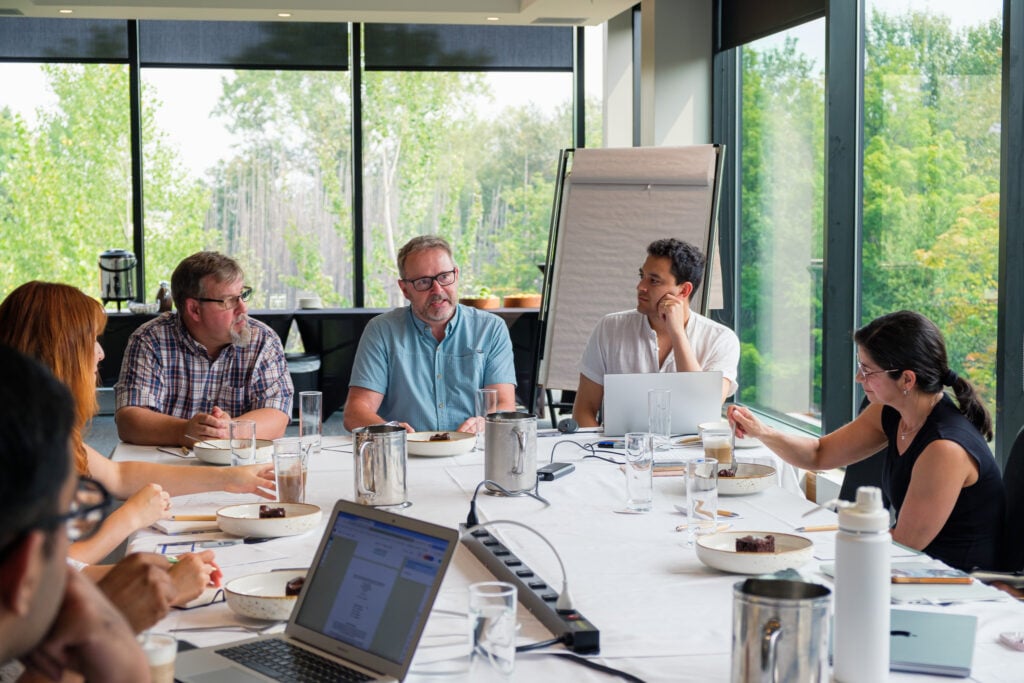
Photo by Tristan Olif
Over the last 6 months, I have had the privilege to co-lead a strategic planning process for the Faculty of Social Work at Wilfrid Laurier University with my colleague Andrew Taylor. It’s the first time we’ve formally teamed up to co-lead a strategic plan. We’ve both done them. We’ve both supported them before. But doing it together, in partnership, has been an incredible learning opportunity for me.
I’m learning that one of the most powerful ways to grow is to partner closely with someone whose instincts are different from yours. Andrew and I approach strategy from slightly different angles. If we were to map ourselves (loosely) onto something like the Kolbe, I’d say I’m a mix of an implementer and a follow-through. I like movement. I’m comfortable progressing even when every variable isn’t perfectly resolved. I care about structure, timelines, and making sure commitments turn into action.
Andrew, by contrast, has the instincts of a careful fact-finder. He takes time to ensure that each step is grounded in what we’ve heard: in interviews, surveys, environmental scans, and past reports. He listens deeply. In meetings, he pauses. He synthesizes. He’ll often summarize in a way that makes everyone feel accurately understood.
Neither of these approaches is better. But together, they create something stronger than either of us alone. In our work with Laurier’s Faculty of Social Work, I’ve noticed a rhythm emerging. Andrew anchors us in what has been said. He ensures we don’t overreach, don’t skip steps, and don’t mistake a loud idea for a representative one. He keeps us accountable to what the community actually expressed.
I tend to hold the arc of the process. In facilitation, I animate, guide, and keep the energy moving. I think about how we move from themes to choices, from aspirations to priorities, from priorities to actions. I’m often the one asking: What does this mean for next year? What changes because of this?
The result is a strategy that feels deeply grounded in listening and also capable of movement.
One thing this partnership has clarified for me is that “data” in strategic planning isn’t just numbers. It’s stories. It’s patterns across conversations. It’s tensions. It’s what people hesitate to say. Andrew has a real gift for treating that material with care, not rushing to conclusions, not forcing coherence too early.
At the same time, strategy cannot live forever in analysis. Institutions are busy. Organizations are stretched. Community needs are evolving. A strategic plan has to translate listening into direction. Where I think I contribute most is in that translation: helping the group move from insight to decision, and from decision to action. What are we committing to? What are we not doing? How will this show up in practice?
We tend to move through three phases.
- First, careful listening. Not consultation for its own sake, but structured conversations that help us understand patterns, tensions, and trade-offs.
- Then, returning those themes to the group. We ask: Does this feel accurate? What’s missing? Where are we not aligned?
- Finally, narrowing. Turning broad aspirations into a small number of concrete, time-bound commitments.
And throughout, clear communication with our partners at the Faculty, so nothing feels mysterious or abstract.
Co-leading this process has reminded me that strategy is relational work. It’s not about imposing a framework. It’s about building enough trust and clarity that people can make hard choices together. I’ve also been reminded that contrast is a gift. Working alongside someone whose instincts differ from yours forces you to slow down in the right places and move forward in others.
I don’t think either Andrew or I would describe this as dramatic or flashy work. It’s careful. It’s iterative. It’s often quiet. But when it works, you can feel it: a group that feels heard, a direction that feels credible, and a plan that people are actually willing to implement.
Co-leading this process has made my own instincts more visible to me: where I push, where I assume readiness, where I want closure. It’s also made me appreciate the discipline of slowing down. Working across different strategic instincts isn’t always seamless. It requires trust, clarity, and a willingness to be influenced.
And that’s the kind of partnership I want to keep building.